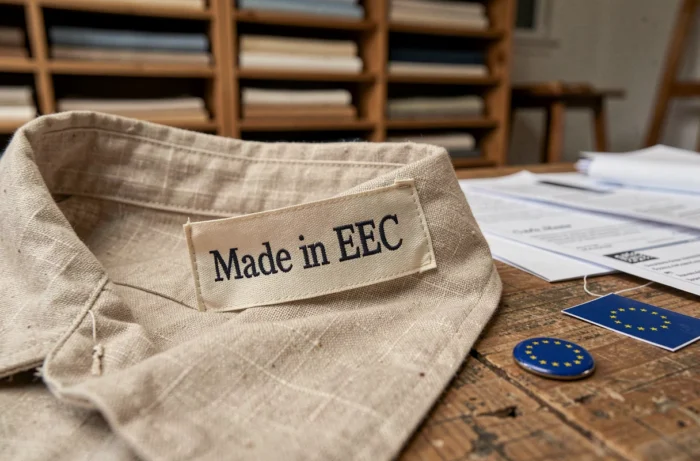
You may have already come across an antique item, a camera, or a vintage toy, and read on the label “Made in EEC.” Three letters that do not correspond to any country on a map. This inscription, inherited from a bygone era of European construction, remains present on millions of products still in circulation. Understanding its meaning allows you to date an object, assess its origin, and avoid certain confusions with current markings.
Made in EEC and rules of origin: what the marking says (and does not say) about the product
EEC is the English acronym for European Economic Community, which is the Communauté économique européenne (CEE) in French. This entity existed from 1957 to 1993, when the Maastricht Treaty transformed it into the European Community, and then into the European Union.
A product bearing the mention “Made in EEC” was therefore manufactured, or at least substantially transformed, in one of the member states of this community before 1993. The number of concerned countries varied over time with expansions: six founding members (France, Germany, Italy, Belgium, Netherlands, Luxembourg), then nine, ten, twelve.
When you read the mention made in EEC on a product, it does not specify which member country manufactured it. It is a regional indication, not a national one. An item stamped “Made in EEC” could come from Germany, Italy, or France, without being able to determine from the marking alone.
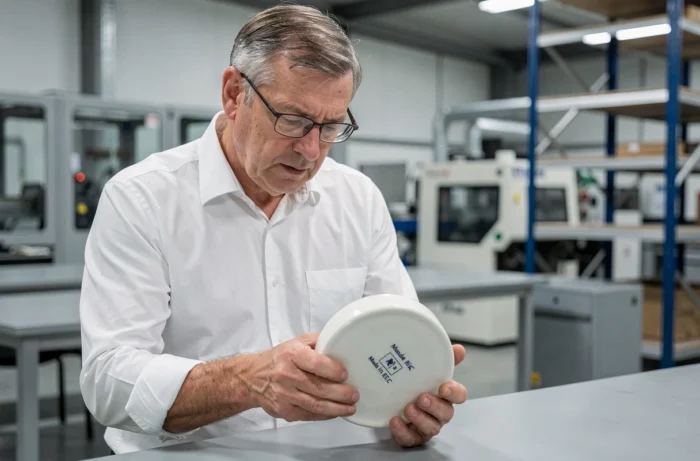
The origin marking was never mandatory in the EEC for non-food products. This is a point that many are unaware of. Unlike the United States, Japan, or China, which impose origin labeling on imported goods, Europe has always left this process to the choice of the manufacturer or importer. The law only prohibits false indications of origin, meaning affixing misleading markings.
CE marking, quality label, origin indication: three concepts not to be confused
Have you noticed the letters “CE” on most electrical devices sold in Europe? This symbol means “Conformité Européenne.” It certifies that a product complies with the safety, health, and environmental protection standards of the European Union. The CE marking is not a geographical origin indication.
This confusion is common. A product made in China or Vietnam can perfectly bear the CE marking if it meets European regulatory requirements. In contrast, a product “Made in EEC” indicates manufacturing within the former community space, without guaranteeing its compliance with current standards.
Quality labels (such as IGP or appellations d’origine) constitute yet another category. They certify a know-how, a terroir, or a manufacturing process. A product can be made in France without any label, and a labeled product can contain imported raw materials.
Here are the distinctions to remember:
- “Made in EEC” or “Made in France”: voluntary geographical indication, not mandatory for non-food products in the EU
- CE marking: declaration of regulatory compliance, mandatory for certain categories of products, unrelated to the place of manufacture
- Quality labels (IGP, EPV, Origine France Garantie): voluntary certifications attesting to a specific specification related to a territory or process
Dating an object using the Made in EEC mention
For collectors and flea market enthusiasts, this inscription is a valuable chronological marker. An item marked “Made in EEC” dates from before 1993. If the mention indicates “Made in EC” (European Community), it was produced between approximately 1993 and 2009. And “Made in EU” corresponds to the current period.
The mention allows you to place a product within a manufacturing window of a few decades. Combined with other clues (design, materials, barcode), it helps authenticate a vintage item or spot a recent counterfeit that would use an obsolete marking.

Beware of a common trap: some products made in the 1980s bear both “Made in EEC” and “Made in” followed by a specific country (for example, “Made in W. Germany”). In this case, the national marking is more informative, with the EEC marking serving as a supplementary mention for export markets outside Europe.
Rules of origin in Europe: a changing framework
The debate over “Made in” Europe is not limited to old items. The rules of origin within the European Union are evolving towards increasingly sector-specific approaches. Rather than a single definition of “made in Europe,” institutions are tending to adapt criteria by production sector.
The digitization of origin proofs is also progressing. Customs procedures, long based on paper certificates, are gradually integrating electronic systems. This transition is changing how companies declare and prove the origin of their products.
Origin has become a market access lever, not just a marketing tool. Bilateral agreements between the EU and its trading partners (including with Turkey for certain agricultural products) are regularly updated, with redefined protocols that concretely change the conditions of import and export.
- Food products remain the only ones for which origin marking is mandatory in the EU
- For manufactured goods, affixing remains voluntary but framed by the prohibition of misleading mentions
- Origin requirements may vary depending on the concerned third country and product category, making the regulatory landscape complex for importers
A product “Made in EEC” found at a flea market tells a story of a time when six, then twelve countries shared a common market without the current regulatory layers. Understanding this marking is to read a concrete trace of European commercial history, useful both for dating an object and grasping the logic of a labeling system that continues to evolve.