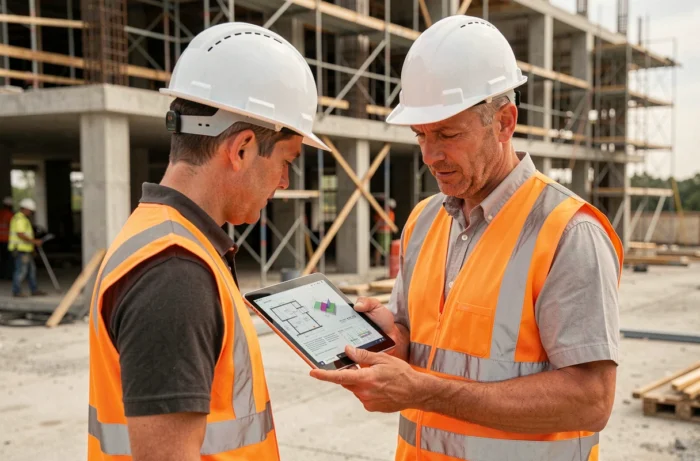
On a construction site, a site manager still spends part of their day re-entering data into a spreadsheet, then emailing it to the design office. The file sometimes arrives in the wrong version. The schedule gets pushed back. Tailored digitalization in construction aims to address exactly this type of friction: replacing makeshift software with tools designed for the actual workflows of a given site.
Generic tools versus site-specific solutions: what really holds things up
Most construction companies are already using software. Spreadsheets, photo tracking applications, instant messaging. The problem does not stem from a lack of digital tools, but from the coexistence of tools that do not communicate with each other.
A survey by the Royal Institution of Chartered Surveyors (RICS), published in its AI in Construction Report 2025 and conducted among over 2,200 professionals, confirms that the lack of integration between systems hinders the digital transformation of the sector. The data exists, but it remains siloed in incompatible files.
The tailored digitalization in construction starts from a simple observation: each company has its own validation processes, trades, and site constraints. A tool designed for a real estate developer may not necessarily be suitable for a craftsman specializing in energy renovation.
Adapting the tool to the existing workflow, rather than forcing the team to change its habits to fit a standard software, reduces training time and limits usage rejection.
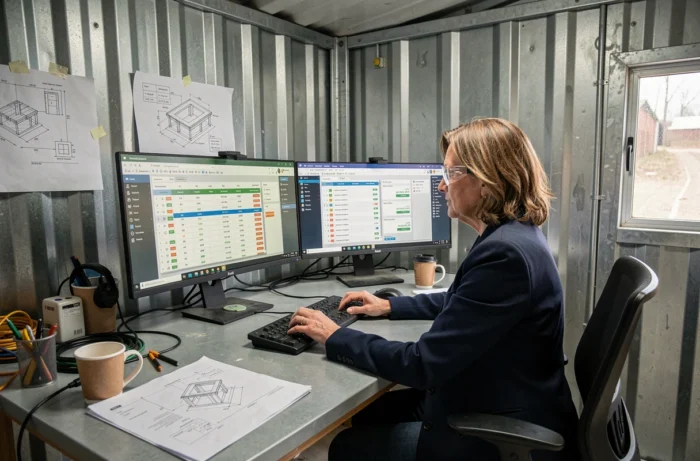
Offline functionality: a criterion that commercial brochures overlook
Have you ever tried to load a plan on a tablet in the basement of a building under construction? Network coverage on site remains a blind spot for many digital solutions.
A practical guide for construction companies recommends testing, during a pilot phase, the synchronization of forms and photos without a network connection. If the tool does not work offline, it becomes unusable in the most common construction areas: basements, tunnels, rural areas far from antennas.
This field test, sometimes called a “technology stress test,” covers several concrete points:
- Entering reports and reservations without a 4G signal, with automatic synchronization as soon as back in a covered area.
- Data exchange between the construction software and existing systems (accounting, planning, BIM) without double manual entry.
- Consulting plans and technical documents locally, directly on the site manager’s tablet or smartphone.
A custom software can integrate these constraints from its design. A generic tool often requires makeshift workarounds.
Cybersecurity on site: a risk that has become real
IT security is no longer a topic reserved for headquarters. Site data now travels on shared tablets and temporary Wi-Fi networks. Plans, quotes, subcontractor contact details, geolocated photos: the amount of sensitive information handled on site has significantly increased.
Recent recommendations emphasize data encryption and rigorous management of user access, including for temporary workers and subcontractors who join the site for just a few weeks.
A custom digital tool allows for defining differentiated access levels by trade. The plumber can consult their plans and intervention sheets. The site manager accesses the overall schedule and financial indicators. The project owner tracks progress without seeing the details of internal costing. This granularity is rarely offered by off-the-shelf solutions.
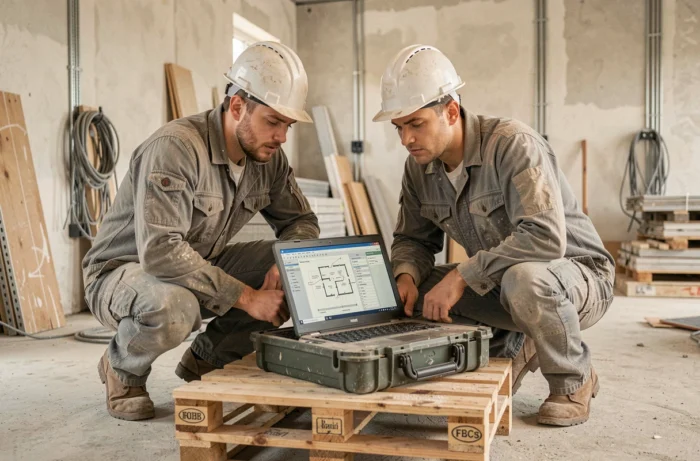
BIM and digital models: tailored solutions as a bridge
BIM (Building Information Modeling) structures information around a digital model shared among architects, engineers, and builders. Its adoption is progressing, but many companies struggle to connect BIM to their daily management tools.
The gap is common: the 3D model contains precise data on materials, quantities, and timelines. The construction tracking software, on the other hand, works with its own tables. Without a bridge between the two, teams manually re-enter what already exists in the model.
A digital solution tailored to the company can serve as an interface between the BIM model and operational processes:
- Automatic extraction of quantities from the model to the material ordering software.
- Updating the schedule based on changes made to the 3D model by the design office.
- Reporting site reservations directly in the model, with geolocation and timestamp.
This integration avoids the classic drift where BIM remains a beautiful presentation object, disconnected from the reality of the site.
What a tailored approach really changes for construction companies
The digitalization of construction is not just about installing another piece of software on workstations. The challenge lies in the ability to circulate the right data, at the right time, to the right person, even when the network goes down or when a temporary worker arrives on Monday morning without prior training.
A custom digital tool reduces friction rather than creating new ones. It adapts to the practices of the site instead of imposing a theoretical model. This logic distinguishes sustainable digitalization projects from those that teams abandon after a few weeks.
The construction sector remains one of the least digitized in the economy. There is ample room for improvement, provided that the chosen tools correspond to the realities of the field, not to the promises of a commercial demonstration in a meeting room.