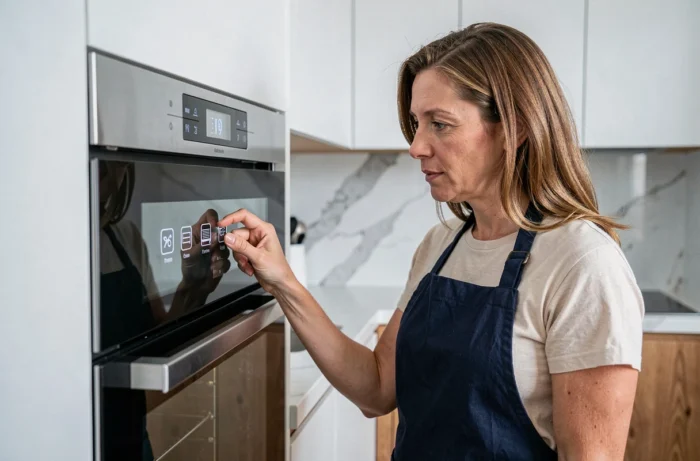
We start a gratin, we turn the dial to the first pictogram that comes up, and twenty minutes later the cheese is barely melted while the bottom is burnt. The problem rarely comes from the oven itself: it’s the cooking mode selected that doesn’t match the dish. Understanding the oven cooking symbols avoids this kind of mishap and allows us to utilize functions that we often overlook.
Reading an oven pictogram: the graphic logic behind each line
Before detailing each mode, we save time by understanding the basic principle. Manufacturers (Bosch, Siemens, Whirlpool, Electrolux, Neff, Sauter) use a common visual vocabulary, even though the design varies slightly from one brand to another.
- A horizontal line represents a heating element: placed at the top, it’s the top heat; at the bottom, it’s the bottom heat; both together represent natural convection (or traditional heat).
- A fan (three or four-blade propeller) indicates that hot air is circulated inside the chamber, which provides circulating heat.
- A zigzag at the top of the square symbolizes the grill, a high-intensity heating element that heats by direct radiation.
- A snowflake, sometimes accompanied by drops, indicates the defrost function: the fan runs without heating.
To properly decode the oven cooking symbols, we always start from these three graphic elements: line, fan, zigzag. The rest is just a combination of these building blocks.
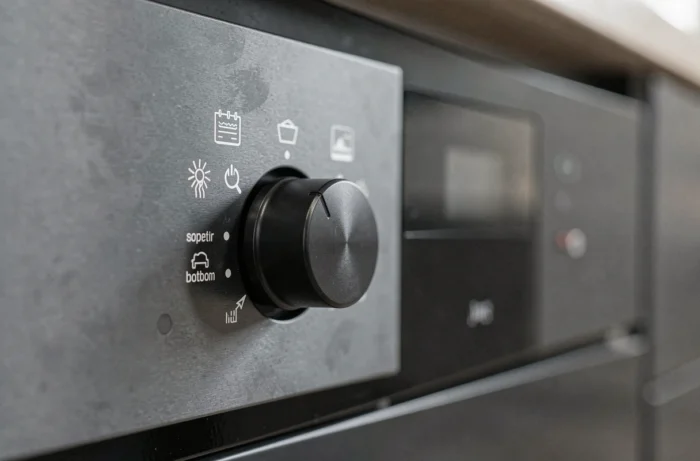
Convection or natural heat: which symbol for which result
This is the most common confusion. We use the circulating heat for everything, while some dishes fare better with natural convection.
Natural convection (two lines, no fan)
The top and bottom heating elements heat at the same time. The air is not circulated. Heat rises naturally, creating a slight temperature difference between the top and bottom of the chamber.
This mode is suitable for preparations that need a slow and enveloping cooking: cakes, brioches, soufflés. The top browns gradually without the inside drying out.
Circulating heat (fan with or without circle)
The fan redistributes hot air evenly across all levels. You can bake several trays at the same time (cookies, choux) with consistent results.
Downside: the forced air dries out the surface more. For a roast, it gives a marked crust, which can be desirable. For a moist cake, natural convection is often the best choice. Feedback on this point varies by model, but generally, you lower the temperature by 10 to 20 degrees compared to a recipe written for natural convection.
Grill symbol of the oven: when to use it without burning everything
The zigzag at the top of the pictogram activates the top heating element at full power. The heat is intense, concentrated, and only penetrates a few centimeters. This is a finishing mode, not a long cooking mode.
Simple grill or ventilated grill
The simple grill (zigzag alone) heats a small area, just below the heating element. The ventilated grill (zigzag plus fan) expands the heat area by circulating air around the radiation. The ventilated grill is used for a whole chicken or a large piece, and the simple grill for browning a croque-monsieur or vegetables.
In both cases, the door remains closed (contrary to some misconceptions). Monitoring is essential: between perfect browning and burnt, sometimes less than two minutes can pass.

Special modes: bottom heat only, defrosting, and pyrolysis
Bottom heat only (line at the bottom only)
The bottom heating element heats without assistance from the top. This mode is mainly used to finish cooking a crust that lacks crispness underneath: pizza base, tart, quiche. It is sometimes combined with a quick grill at the end of the cycle to brown the top.
Defrosting (snowflake)
The fan runs at room temperature. No heating element is activated. Air circulates around the food and speeds up defrosting without starting cooking. This mode preserves texture better than a microwave, especially for puff pastry or meats.
Pyrolysis (lock or diamond symbol)
The oven heats to a very high temperature to incinerate grease residues. The door automatically locks during the cycle. This is not a cooking mode: it is a self-cleaning program that usually lasts more than an hour. It is started with the oven empty, without the racks if the manual recommends it.
Matching the right symbol to each type of dish
Here we summarize the most reliable associations between the cooking mode and the category of preparation.
- Cake, loaf, brioche: natural convection (two lines), moderate temperature, rack in the middle of the oven.
- Pizza, thin tart, bread: bottom heat for the base, then circulating heat or quick grill for the top.
- Roast, whole poultry: circulating heat for even cooking, or ventilated grill for crispy skin.
- Gratin, croque-monsieur: simple grill, dish placed on the top rack, constant monitoring.
- Simultaneous cooking on multiple levels (batch of cookies, trays of vegetables): circulating heat, the only mode truly suited for this configuration.
The symbol displayed on the dial or screen remains the starting point. When a dish does not yield the expected result, we first check that we have selected the correct pictogram before questioning the recipe or temperature. A well-used oven is, above all, an oven whose control panel is read correctly.