
When a team deploys an internal chatbot and discovers three months later that the model used falls under the European AI Act, the tech trend is no longer an abstract monitoring topic. It becomes an operational constraint to address before the next production rollout.
The tech trends of 2024 are distinguished from previous years by this shift: we are no longer just talking about adoption, but about compliance, technical documentation, and architectural choices that commit the company for several years.
European AI Act: the game-changing timeline for tech teams
The AI Act came into effect on August 1, 2024, but its implementation follows a gradual timeline that many companies have not yet integrated into their roadmap. The first obligations, including the prohibition of certain practices and mastery of AI, began to apply on February 2, 2025. The rules targeting general-purpose AI models became applicable on August 2, 2025.
In practical terms, this means that any company using a generative model must document its uses and check which risk category it falls into. This is not a theoretical exercise: it involves producing technical documentation, ensuring traceability of training datasets, and guaranteeing transparency regarding synthetic content.
The regulation also imposes transparency obligations on chatbots, AI-generated content, and deepfakes. For a development team integrating generative AI components into its applications, this represents a mapping and compliance workload that did not exist a year ago. Regularly following tech topics on 24 Actualités helps ensure that concrete deadlines for this type of regulation are not missed.

Generative AI in production: the gap between prototype and real deployment
The majority of competitors discuss generative AI from the perspective of promise. In practice, the situation is different. The transition from prototype to production remains the main bottleneck for companies trying to integrate these models into their business processes.
The difficulties are specific. There are consistently three obstacles that slow down production rollouts:
- The quality and traceability of training data, which the AI Act now makes mandatory for certain categories of systems
- The inference cost of large models, which skyrockets as soon as you move from a few internal users to customer exposure
- Integration into existing information systems, where cloud architectures and solutions from Microsoft or other providers are not always ready to accommodate these components without redesign
Feedback on this point varies depending on the size of the company and the sector. A small business connecting an AI coding assistant to its development environment does not encounter the same frictions as a group deploying a generative model on sensitive customer data.
AI coding assistants: a growing usage
Among the most widely adopted concrete applications, AI coding assistants are transforming developers’ daily lives. The adoption of these tools is rapidly increasing within enterprise development teams.
The impact is not limited to the speed of code writing. There is also a reduction in errors in testing and application delivery processes. For web teams and business application developers, this represents a change in work methodology, not just a gadget.
Cloud architectures and modular data: why 2024 choices have long-term implications
The cloud is no longer a trend; it is a given. What changes in 2024 is the rise of modular data architectures that allow for the decoupling of storage, processing, and data exposure. This approach addresses a concrete need: companies want to be able to change technical components (an analysis engine, a visualization tool) without overhauling their entire infrastructure.
For enterprise solutions, this modularity changes the purchasing logic. One no longer chooses a single vendor for the entire data chain. Instead, specialized components are assembled, which requires integration skills that many organizations do not yet have in-house.
Cybersecurity integrated into data pipelines
The other direct consequence of these modular architectures is the widening of the attack surface. Each connector between two components represents a potential vulnerability point. Cybersecurity can no longer be treated in isolation, separate from data engineering.
Companies deploying distributed cloud architectures must integrate security directly into data pipelines, not as an additional layer afterward. This involves tool choices, continuous audit processes, and upskilling data teams on security issues.
User experience and design: what AI changes in web development
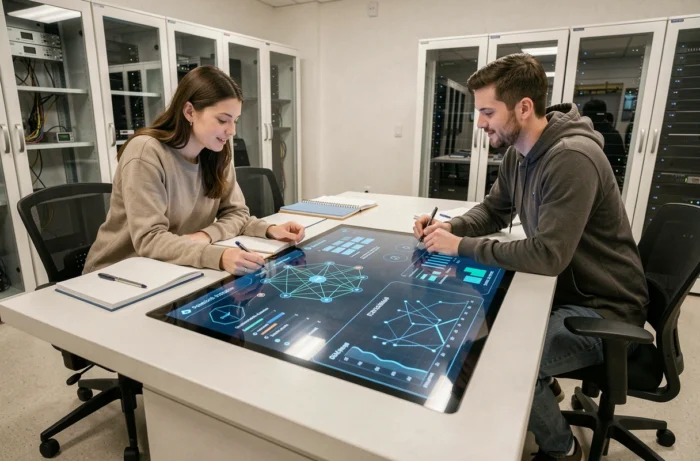
On the web development and application design side, generative AI is beginning to modify production workflows. Tools for generating interfaces, automated prototyping, and personalizing user experience are multiplying.
The most tangible impact concerns personalization. The models allow for real-time adaptation of content, navigation, and product recommendations based on each user’s behavior. For companies selling online, this is a measurable lever on conversion rates.
But caution: personalizing the experience with AI requires compliance with the transparency rules imposed by the AI Act. If a user interacts with a chatbot or receives automatically generated content, they must be informed. This obligation changes how interfaces are designed.
The tech trends of 2024 are not just a list of promising technologies. They are characterized by the emergence of concrete regulatory constraints, the persistent gap between experimentation and production rollout, and architectural choices that will determine companies’ ability to evolve in the coming years. The best technological monitoring this year consists less of spotting the next innovation and more of checking whether what has already been deployed is compliant and scalable.