The French-speaking web hosting market includes several dozen players, each making promises of performance, security, and simplicity. In this context, choosing an offer is less about comparing prices and more about verifying the actual technical compatibility with your project, the location of the data, and the quality of the administration interface on a daily basis.
N0C Panel and the Hidden Cost of Migrating Hosts
Most web hosting comparisons focus on loading speed or the number of allowed sites. One parameter that is rarely highlighted concerns the administration interface itself.
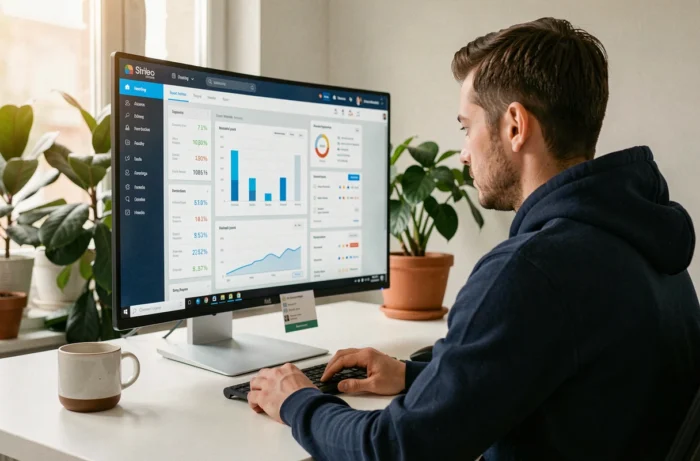
World 24, through its infrastructure, uses the proprietary panel N0C and not cPanel. For an individual launching their first site, the difference remains anecdotal. For a web agency accustomed to cPanel for years, changing the environment represents a real migration cost: training time, adaptation of internal procedures, automation scripts to rewrite.
Before subscribing, it is better to test the interface in real conditions to assess whether routine tasks (DNS management, database creation, SSH access) can be performed smoothly. A high-performing host whose control panel slows down your daily workflow ultimately costs more than a slightly slower competitor whose tool you already master.
This practical dimension often distinguishes hosting on World 24 from competing offers that rely solely on raw speed metrics.

Data Center Location and GDPR Compliance
The choice of data center goes beyond latency issues. The location of the servers determines the applicable law for hosted data, a point that many users underestimate.
Some offers allow you to choose between France, Switzerland, and Canada. If your data is subject to GDPR, opting for a Canadian data center cannot be considered equivalent to hosting within the European Union without first verifying the contractual guarantees.
- A data center in France or Switzerland simplifies compliance for European companies, as international transfers of personal data are governed by specific clauses.
- The contract’s reversibility clauses deserve careful reading: in the event of a host change, full data recovery must be guaranteed and documented.
- The location of automatic backups may differ from that of the main server, further complicating the mapping of data flows.
On this last point, the publicly available information is not perfectly consistent. One source mentions automatic backups retained for 45 days, while another refers to backups every 12 hours on a secondary data center. This discrepancy justifies requesting written clarification before any commitment.
Technical Compatibility Beyond WordPress
WordPress captures the attention of most hosting comparisons. However, World 24’s offer goes beyond just the dominant CMS.
Recent feedback indicates that the environment supports multiple runtimes: PHP, Node.js, Python, and Ruby, as well as Redis and Memcached caching systems. For a developer deploying an API in Node.js or a Python application, this versatility avoids the need to multiply providers.
The limitations specific to each type of project should be verified on a case-by-case basis. The available runtime versions, the resources allocated per container, and any restrictions on long processes vary according to the plans. A showcase site in PHP does not have the same requirements as a continuously running data processing service in Python.
Shared or Dedicated Project: What Level of Isolation
The classic shared architecture divides server resources among multiple clients. The “web projects” approach proposed here isolates each project in its own environment, which is similar to how a VPS operates without the administrative complexity.
This isolation limits the risk of contamination between sites hosted on the same physical machine. A compromised site on the server should not affect other projects. However, field feedback varies on this point when it comes to simultaneous load spikes: the isolation of CPU and memory resources is not always documented precisely.
Web Security and Integrated Protection Layers
Security is a key criterion in choosing a host. Several layers of protection are common in market offers: SSL certificates, web application firewalls (WAF), malware detection, DDoS protection.
The real issue is not the number of listed features, but their default activation and maintenance over time. An included SSL certificate protects nothing if its renewal is not automated. A poorly configured WAF can block legitimate requests and degrade the user experience.
- Check if security patches for WordPress (or any other CMS) are applied automatically or left to your responsibility.
- Ask if the web application firewall is enabled by default on new projects or if it requires manual configuration.
- Identify the notification time frame in case of a detected security incident on your hosting.
These operational details separate a host that markets security as a selling point from a provider that genuinely integrates it into its daily operations.
The choice of web hosting commits you for several months, sometimes several years. Migrating to another provider is technically possible but rarely free in terms of time. Taking the time to test the interface, verify the actual location of the data, and read the reversibility clauses before signing helps avoid the unpleasant surprises that promotional pages do not mention.