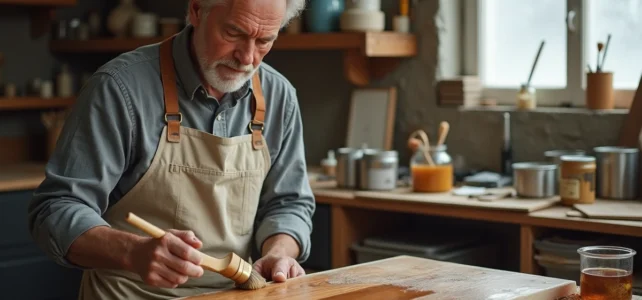
The stain forms a film on the surface of the wood. The saturator penetrates its fibers without creating a visible layer. This functional distinction conditions everything else: the type of suitable support, the visual rendering, the frequency of maintenance, and the method of renovation.
Film-forming product versus impregnating product: the mechanism that changes everything
The stain deposits a microporous film on the surface of the wood. This film allows water vapor to escape from the inside to the outside, but blocks rainwater and filters some UV rays. The grain remains visible under this semi-transparent layer, unlike paint which masks the wood.
Related reading : How to Choose the Ideal Colors for a Minimalist and Sophisticated Look
The saturator works in the opposite way. It infiltrates the fibers, saturating them with oils (vegetable or mineral depending on the formulations) and leaves no film on the surface. The wood retains its raw feel. Water beads on the surface as long as the fibers remain saturated, then the product gradually depletes through leaching and exposure to UV rays.
This difference in mechanism has a direct consequence on aging. A stain at the end of its life can crack, powder, or peel, requiring sanding or stripping before renewing the protection. A saturator, on the other hand, disappears through regular wear: the wood grays, but there is nothing to scrape off. To understand the difference between stain and saturator, this point deserves to be prioritized, as it determines the level of maintenance over time.
See also : How to distinguish between webmail, academic messaging, and ENT for teachers and students
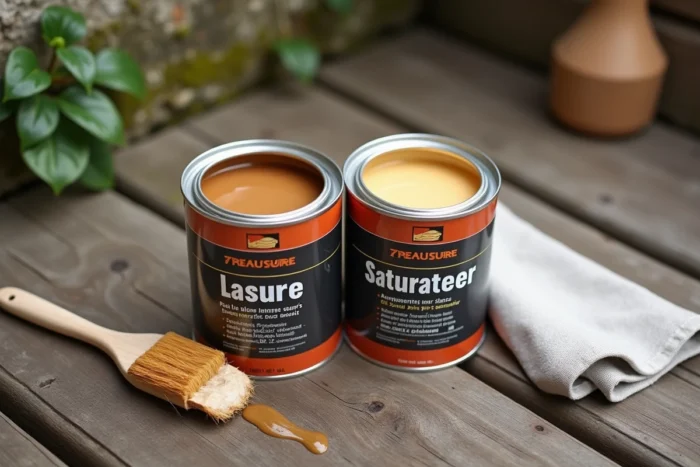
Horizontal or vertical surface: the orientation criterion for wood
Manufacturers recommend the saturator for horizontal surfaces (terraces, decking, coping stones) and the stain for vertical or sloped surfaces (cladding, shutters, gates, fences). This is not an arbitrary convention.
On a terrace, foot traffic and the runoff of stagnant water quickly degrade a film of stain. Mechanical wear causes localized peeling, and water infiltrates through these micro-cracks under the film, accelerating rotting. A saturator does not pose this problem since there is no film to damage.
On vertical cladding, water flows without stagnating, and no one walks on it. The film of stain lasts much longer under these conditions. It also offers more durable UV protection than the saturator, which washes off more quickly under the driving rain of an exposed facade.
Particular case of garden furniture and outdoor stairs
Garden furniture and stairs combine mechanical abrasion and exposure to the elements. The saturator is generally more suitable because renovation can be done without prior sanding: a simple cleaning followed by a new coat is sufficient. On furniture, sanding the moldings and joints is tedious, making the stain less practical to maintain.
Maintenance and renovation: the constraint that labels do not detail
The choice between stain and saturator commits to a maintenance cycle that must be anticipated before the first application.
- Stain: protection generally lasts several years on a sheltered vertical surface. When it deteriorates, it is necessary to sand or strip the damaged areas, dust, and then apply two to three coats. The drying time between coats varies depending on the products, but plan for a full day of work for a medium-sized cladding.
- Saturator: the renewal frequency is shorter, often every one to two years on an exposed terrace. Renovation involves cleaning the wood (brush, pressure washer), allowing it to dry, and then applying a single coat with a wide brush or roller. The operation is quick and does not require special skills.
- Change of product: switching from a stain to a saturator requires completely removing the existing film through sanding or chemical stripping. The reverse (saturator to stain) is simpler since there is no film to remove, but the wood must be clean and dry.
The overall cost over ten years therefore depends as much on maintenance labor as on the price of the product itself. A saturator costs less in renovation effort but is renewed more often, while a stain lasts longer but requires significant preparation work when it fails.
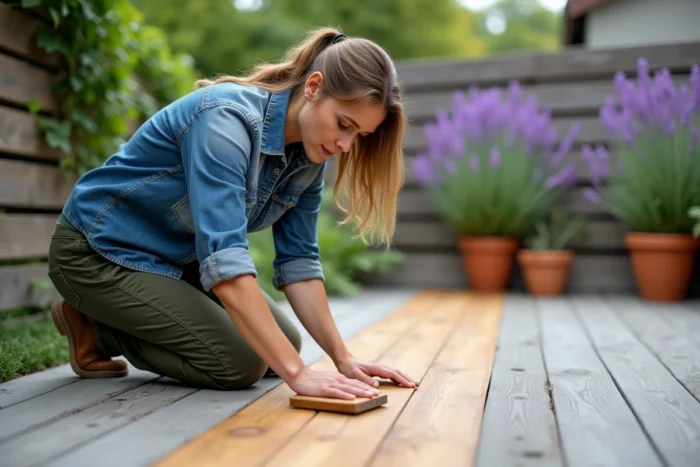
Hybrid products and new formulations for outdoor wood
The classic distinction between film-forming stain and non-film-forming saturator is becoming less clear with the emergence of hybrid products. Since the mid-2020s, some manufacturers have been offering cream or gel formulations that combine the penetration of a saturator with a slight protective film on the surface.
The goal is to simplify renovation (less sanding than a classic stain) while providing UV resistance superior to that of a pure saturator. These products are still recent, and their behavior over several aging cycles has not yet been established compared to traditional formulations.
At the same time, European regulatory requirements are pushing the wood sector towards less polluting surface treatments that are more compatible with sustainable forest management. This movement is guiding manufacturers towards water-based and certified vegetable oils, which is gradually changing the composition of both saturators and stains.
How to choose between stain, saturator, and hybrid product
The decision grid boils down to three questions:
- Is the support horizontal and walked on (terrace, decking)? Saturator.
- Is the support vertical or not mechanically stressed (cladding, shutters)? Stain.
- Does the support combine abrasion and exposure, and is ease of maintenance a priority? Hybrid product or saturator, depending on budget and product availability.
The right product is the one whose maintenance cycle corresponds to your reality. A terrace treated with a saturator and refreshed every spring in an hour will age better than a stained terrace whose cracked film is never renewed. The same reasoning applies in reverse for cladding: a well-maintained stain protects the wood in the long term without frequent intervention.