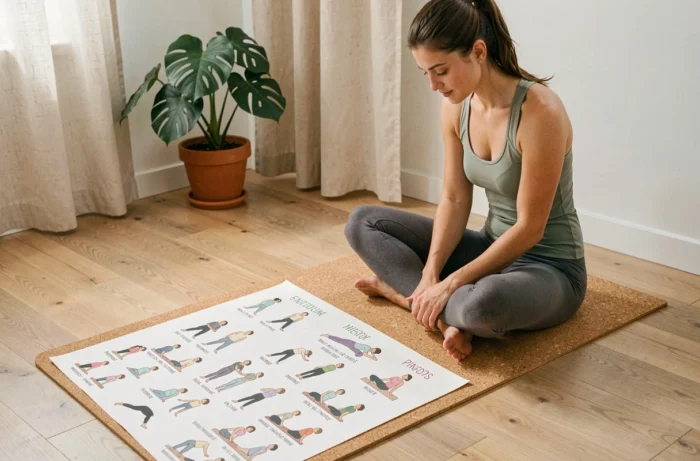
You have been practicing yoga for a few weeks, you know a handful of postures, but when it comes to building your session, you stack the asanas randomly. The result: unbalanced sequences, forgotten muscle groups, and sometimes a frustration that spoils the enjoyment. A chart that classifies the postures by families changes the game because it makes visible what is missing from your practice.
Classifying postures by families to identify imbalances in a session
Before thinking about the order of the postures, you need to understand what each family engages in the body. A family groups asanas that share a common main focus: hip opening, forward bending, back extension, twisting, balancing, or arm strengthening.
When you align your usual postures in a chart, you quickly notice the gaps. Many practitioners accumulate forward bends (seated forward bend, head to knees) and neglect extensions or twists. A chart makes this bias immediate, without needing to memorize the theory.
Specifically, a posture chart on Art de Guérir allows you to visualize each family of asanas and check at a glance if your session covers the body in a balanced way.
A good chart serves as a mirror, not as an imposed program. It shows what you are already doing and what you are avoiding, often without knowing it. Twists, for example, are frequently forgotten even though they mobilize the spine and the deep trunk muscles.
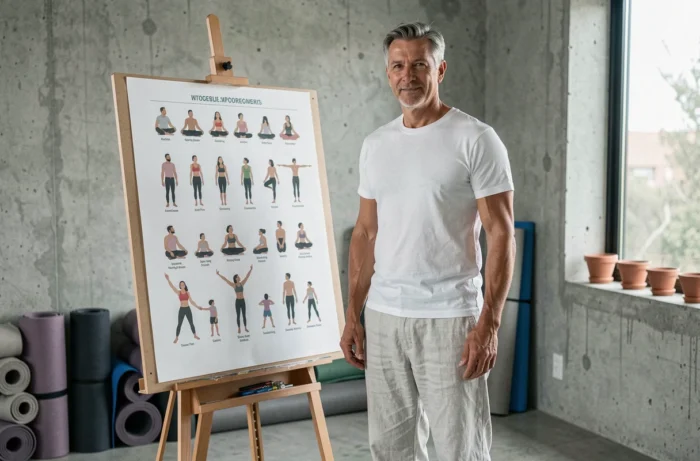
Yoga posture families: the six categories to know
Have you ever noticed that some postures look similar in body shape? This commonality corresponds to a family. Here are the six main categories that structure most practices.
- Standing postures (warrior, triangle, chair): they strengthen the legs, open the hips, and work on grounding. They are often where a dynamic session begins.
- Forward bends (standing forward bend, head to knees): they stretch the back of the legs and calm the nervous system. Useful in the middle or end of a session.
- Extensions and backbends (cobra, bridge, bow): they open the chest and mobilize the spine in the opposite direction to forward bends. Placing at least one extension after a series of bends protects the balance of the back.
- Twists (seated half twist, lying twist): they engage the spine in rotation and the deep trunk muscles. Two or three twists are sufficient in a standard session.
- Balance postures (tree, dancer, eagle): they develop proprioception and concentration. One well-held balance posture is better than three done without stability.
- Floor postures and gentle inversions (child’s pose, candle, legs up the wall): they serve as recovery, transition, or closure. They slow the heart rate and prepare for relaxation.
This classification is not rigid. Some postures belong to two families: warrior III combines balance and leg strengthening. The chart serves as a reference, not a mandatory box.
Adapting the number of families to the level of practice
A beginner using three families per session (standing postures, forward bends, floor postures) is already progressing coherently. Adding twists and extensions comes naturally after a few weeks, when the body has gained flexibility and awareness of its supports.
It is better to explore three families well than to skim over six. The chart helps you choose knowledgeably, not to cram everything into one hour of practice.
Building a balanced yoga session with the chart
The chart does not dictate a fixed order, but it allows you to script your session based on your goal for the day. Why this choice? Because the order of the families alters the overall effect of the practice.
Morning session: prioritize gradual mobilization
Start with floor postures (cat-cow to awaken the spine), move to standing postures to activate the legs, then finish with one or two gentle extensions. Light twists can be interspersed between standing postures. The goal is to gradually increase intensity without jarring the joints.
Evening session: winding down towards calm
Reverse the logic. Start with a few standing postures to release the day’s tensions, quickly follow with forward bends (stretching the hamstrings and hips), integrate seated twists to release the lower back, and finish with floor postures and a long relaxation.
Breath guides the rhythm more than the clock. If a posture requires more breaths for you to settle in, stay there. The chart shows what to do, not how fast.
Short session: choose one posture per family
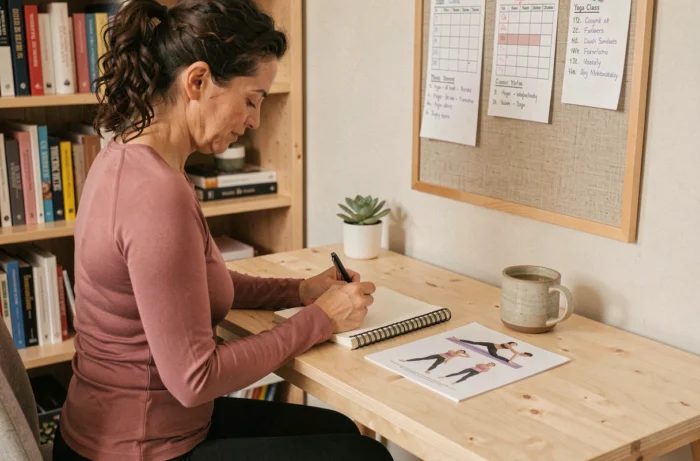
When time is short, select a single posture from each family you wish to work on. Three families, three postures, about ten minutes. The chart makes this sorting quick: you look at your columns, pick, and practice.
Safety and adaptation: what the chart does not replace
A chart classifies postures; it does not correct alignment. Two precautions to keep in mind when building your sessions.
First, each posture has a simplified version that protects the knees, back, and shoulders. Warrior II with a less deep leg angle engages the same muscle groups without straining the knees. Cobra with elbows on the ground spares the lower back. Note these variations in your chart, next to the full version.
Second, adapt the session to your energy at the moment. Recent guides for children and beginners emphasize a point applicable at any age: if attention or motivation wanes, shortening the session or skipping a family is preferable to forcing the planned program. The chart is a tool for choice, not an obligation for a complete path.
A chart of postures by families simplifies the preparation of each session without rigidifying it. By making visible the distribution between balance, twist, extension, and flexion, it transforms a list of asanas into a sequence that respects the body as a whole. The most useful tool remains the one you actually consult before rolling out your mat.