
The threshold of 4 cartons per adult person returning from within the EU is not an acquired right. It is a guideline threshold related to personal consumption, and French customs retains full discretion to assess the actual purpose of the transport. Here, we detail the technical points that most guides gloss over.
Indicative threshold and presumption of personal use: the legal mechanics
Before March 2024, France applied an administrative ceiling of one carton per traveler returning from another member state, well below the European directive. This restriction has been lifted, and French practice now aligns with the European indicative threshold of 800 cigarettes, or 4 cartons.
The term “indicative” has a precise legal scope. Below 800 cigarettes, the presumption favors the traveler: customs automatically assumes that the tobacco is intended for personal use. Beyond that, it is up to the traveler to prove the absence of commercial intent.
Customs agents evaluate several criteria to qualify personal or commercial use:
- The status of the transporter (individual, merchant, cross-border worker) and the frequency of their trips
- The quantity transported relative to the number of adults present in the group
- The packaging of the tobacco (sealed cartons in large quantities, unusual brand mixes, presence of rolling tobacco in large volumes)
- Payment receipts and their consistency with oral declarations
In short, transporting exactly 4 cartons does not guarantee an absence of control. A traveler making frequent round trips with the maximum allowable amount systematically risks reclassification as commercial use, leading to seizure and fines.
For those wishing to bring back cartons of cigarettes from Spain by plane, the distinction between plane, train, and car significantly alters the conditions of control, particularly at the customs checkpoint.
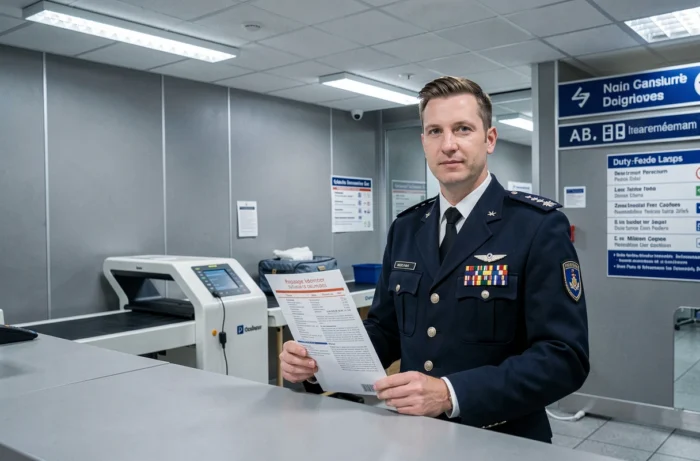
Customs control at the airport: specifics of air transport from Spain
On an intra-EU flight, there is no systematic customs check upon arrival. French airports have “nothing to declare” corridors for flights from the EU. This does not mean an absence of control.
Flying customs officers conduct random checks directly in the disembarkation area or at terminal exits. They particularly target low-cost flights from busy Spanish hubs due to the price differential on tobacco.
Tobacco must travel in the passenger’s luggage, either in the hold or in the cabin. No specific restrictions on air transport further limit the 800 cigarettes of the indicative threshold. However, lighters and matches are subject to standard aviation security rules (one lighter per person, in pocket or cabin baggage, never in the hold).
Difference with land passage
By car, customs checks occur at border crossings, often in a targeted manner. The likelihood of a check varies depending on the border post and the time period. By plane, control is less geographically predictable but just as frequent on certain routes.
Sanctions for exceeding the tobacco threshold
Beyond 800 cigarettes without being able to justify strictly personal use, customs applies a regime of graduated sanctions. The complete confiscation of excess tobacco is systematic.
The customs fine can reach one to two times the value of the duties and taxes evaded. To give a sense of scale, French taxation on tobacco represents the vast majority of the retail price. The tax differential between Spain and France makes the calculation of evaded duties particularly unfavorable for the offender.
A recent case in Haute-Garonne illustrates the level of vigilance of the authorities: a traveler returning from Spain was intercepted with 237 cartons of cigarettes and 35 kg of shisha tobacco. This type of seizure falls under characterized trafficking and exposes one to criminal prosecution, far beyond a simple administrative fine.
Specific case of minors
Only travelers aged 17 and older can benefit from the tobacco exemption. A minor has no exemption. We observe that some travelers attempt to distribute cartons among the entire family group, including minors: this practice is illegal and detected during checks.
Reduced exemptions: Andorra, the Canary Islands, and overseas territories
Continental Spain falls under the intra-EU regime. The Canary Islands and Andorra do not. A flight with a stopover or from the Canary Islands falls under the third-country regime, with significantly lower exemptions.
- Return from the Canary Islands or Andorra: the limit drops to 200 cigarettes, or 1 carton per adult
- Residents and cross-border workers returning from a third country benefit from a reduced value exemption, which can drop to 75 euros per person, with a ceiling of only 40 cigarettes
- The French overseas departments and regions (Guadeloupe, Martinique, Guyana, Réunion, Mayotte) are also considered “other zones”: third-country thresholds apply
The confusion between continental Spain and the Canary Islands remains frequent. A passenger returning from Tenerife with 4 cartons exceeds the authorized exemption of 3 cartons and risks partial seizure.
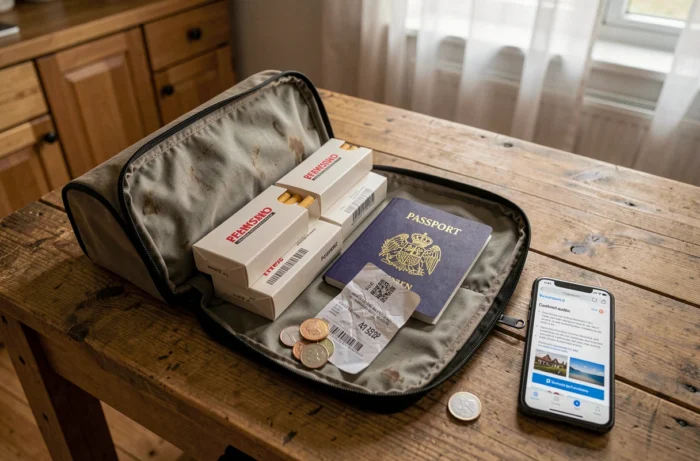
Buying cartons in Spanish duty-free or in the city
The duty-free shops at Spanish airports sometimes display prices higher than those at tobacco shops (estancos) in the city center. The advantage of duty-free mainly exists for flights outside the EU, where tax exemption fully applies.
On an intra-EU flight, the products sold in airport shops are subject to local Spanish taxes. The gain compared to a neighborhood estanco is often marginal, or even nonexistent depending on the brands. We recommend comparing prices before prioritizing purchases in the boarding area.
The receipt is the only enforceable proof in case of a check. Always keep it, regardless of the place of purchase. It serves to prove the quantity purchased, the price paid, and the date of the transaction, three elements that customs examines as a priority.
The price differential between Spain and France remains significant for most common brands. It is precisely this differential that motivates enhanced controls on the relevant airline routes. Staying within the limits of the indicative threshold and keeping proof of purchase remains the only reliable approach to travel without the risk of seizure.